About TADAS project
The TADAS project aims to establish an interoperable antimicrobial resistance (AMR) surveillance system that captures, analyzes, and reports AMR surveillance data from human, animal, and environmental laboratories. This initiative aligns with the Ethiopian National Antimicrobial Resistance strategic plan for 2021-2025 and 2025/26 to 2029/30, which envisions a One Health surveillance network in the country. Since 2018, the WHONET database has been utilized for capturing and reporting AMR data from public health and clinical laboratories, while the International FAO Antimicrobial Resistance Monitoring System (InFARM) has been in use since 2024 for animal and food laboratories in Ethiopia. However, there is currently no AMR surveillance data reporting platform for environmental laboratories, and a lack of standardized data collection protocols for common priority pathogens hampers efforts. Most importantly, the absence of a unified multi-sectoral platform for data capturing, analysis, and reporting hinders the tracking of antimicrobial-resistant bacteria transmission dynamics across human, animal, and environmental domains. To address these critical challenges, the TADAS project is developing an interoperable surveillance system structured around five key work packages (WPs), as illustrated below.
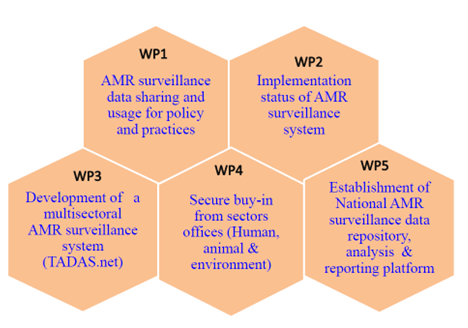
WP1: AMR surveillance data sharing and usage: This work package focuses on evaluating the use of AMR surveillance data for policy formulation and informing clinical practices. We conducted a desk review of policies, strategic plans, manuals, and guidelines. Additionally, we carried out key informant interviews. The assessment findings revealed that data collected through the WHONET system contributed to the revision of essential drugs lists in Ethiopia.
WP2: Implementation status of AMR surveillance system: This assessment involved 22 human laboratories that used the WHONET database, along with one animal and one food laboratory that have implemented the International FAO Antimicrobial Resistance Monitoring System (InFARM). We gathered data from these labs on various aspects of the platform, including functionality, usability, reliability, performance, security, compatibility, scalability, and data integrity. Overall, we evaluated the barriers and facilitators affecting the use of the database to identify gaps that need to be addressed in our newly developed multisectoral data-sharing platform (TADAS. net)
WP3: Development of a Mutisectoral AMR surveillance system (TADAS.net): TADAS.net is a web-based, interoperable surveillance system that captures, analyzes, and reports AMR data from human, animal, and environmental laboratories. It standardizes data collection protocols for both common and priority pathogens, enabling integrated surveillance through a One Health approach. As a unified data platform, TADAS.net enhances collaboration across the human, animal, and environmental health sectors, allowing for more comprehensive analysis of AMR trends and the development of targeted interventions. Additionally, the TADAS team has established data governance guideline to ensure ethical data sharing, promote transparency, and build trust among key One Health sectors.
WP4: Secure buy-in from Key One Health stakeholders: The TADAS team has been working closely with a range of stakeholders, including platform end users, laboratory heads, AMR technical working groups, AMR coordination committee, the IHR/One Health secretariat, and development partners. This collaborative effort aims to ensure that the platform meets stakeholders’ expectations and secures buy-in for ownership by sector offices.
WP5: Establishment of a national AMR surveillance data repository, analysis and reporting platform: The goal of TADAS.net is to serve as a national AMR surveillance data repository, analysis and reporting platform that will contribute to the understanding of AMR transmission across sectors. This will enable the country to fulfil its goal of establishing a national surveillance network that can provide quality data to further inform policies and clinical practices and ultimately, reduce morbidity and mortality due to microbial infections.
Sandpit project
This is one of eight projects funded by the Capacitating One Health in Eastern and Southern Africa (COHESA) project following a call for multidisciplinary One Health project proposals to address local challenges, across the 12 COHESA countries. As part of the Sandpit process, teams pitched their proposals and the winning pitches are promoted, receive funding as well as technical support and mentoring from COHESA.